

Blood Flow Restriction Training
Accelerating Strength and Recovery with Lower Loads
Blood Flow Restriction (BFR) training is a rehabilitation and performance technique that allows patients to build strength and muscle while using significantly lighter weights than traditional strength training.
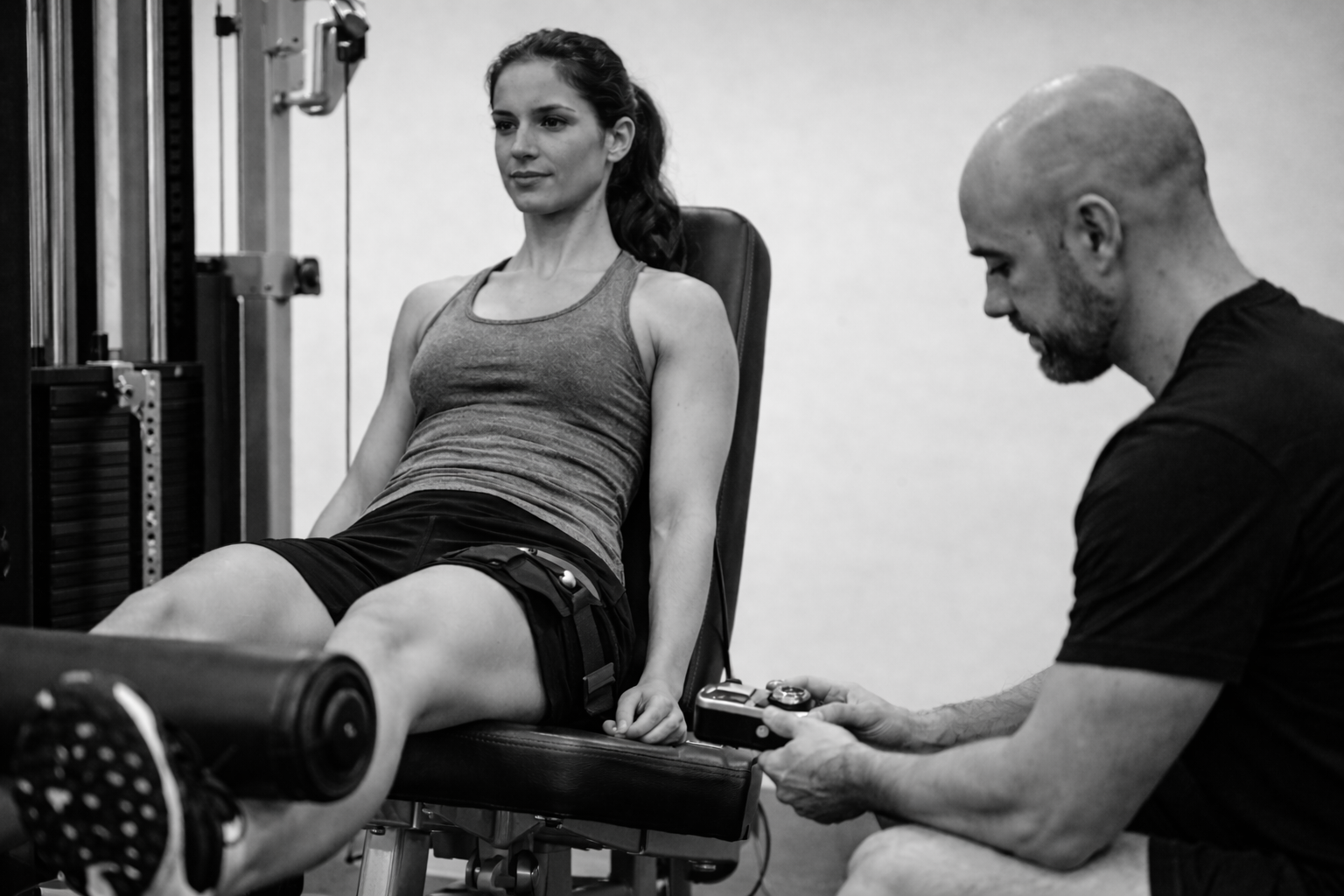
The method involves placing a specialized cuff around the upper portion of the arm or leg while performing exercise. The cuff partially restricts blood flow returning from the working muscles while still allowing arterial blood to enter the limb.
This controlled restriction creates a unique physiological environment in the muscle that stimulates many of the same adaptations normally seen with heavy resistance training.
For patients recovering from injury, surgery, or pain-limited conditions, BFR training can help improve strength while reducing the mechanical stress placed on joints and healing tissues.
How Blood Flow Restriction Training Works
During BFR training, a cuff is applied to the upper arm or thigh and inflated to a specific pressure to partially restrict venous blood flow while allowing arterial circulation to continue.
This restriction leads to several important physiological responses.
Metabolic Stress
Reduced oxygen delivery to the working muscles creates a temporary hypoxic environment. This increases metabolic stress within the muscle, which is one of the primary drivers of muscle growth and strength adaptation.
Increased Muscle Fiber Recruitment
Under normal circumstances, lighter weights primarily activate slower, endurance-oriented muscle fibers. With BFR training, fatigue develops more quickly, forcing the body to recruit larger fast-twitch muscle fibers earlier, which are responsible for strength and power development.
Hormonal and Cellular Responses
Research suggests BFR training can stimulate anabolic signaling pathways involved in muscle growth, including increased muscle protein synthesis and cellular swelling within muscle fibers.
Together, these mechanisms allow low-load exercises—often 20–40% of a person’s one-repetition maximum—to produce meaningful strength and hypertrophy adaptations.
Why BFR Is Useful in Rehabilitation
Traditional strength training often requires lifting relatively heavy loads to stimulate muscle adaptation. However, after injury or surgery, heavy loading may not be appropriate.
BFR training provides an alternative by allowing patients to achieve strength improvements using lighter loads.
This can be particularly beneficial for individuals who:
Are recovering from orthopedic surgery
Experience joint pain during heavy resistance exercise
Have muscle weakness due to injury or inactivity
Need to limit mechanical stress during early rehabilitation
Low-load resistance training combined with BFR can promote strength and muscle growth while minimizing stress on healing tissues.
What the Research Shows
Research on blood flow restriction training has expanded significantly over the past two decades. Numerous systematic reviews and clinical trials have investigated its effects on strength, muscle growth, and rehabilitation outcomes.
Strength and Muscle Growth
Systematic reviews have shown that BFR training can significantly increase muscle strength and hypertrophy, even when using low loads.
Research article:
https://pubmed.ncbi.nlm.nih.gov/21922259/
Comparable Adaptations to Heavy Training
Several studies demonstrate that low-load BFR training can produce muscle hypertrophy similar to traditional high-load resistance training, making it particularly useful when heavy loading is not possible.
Research article:
https://pubmed.ncbi.nlm.nih.gov/30246795/
Benefits for Rehabilitation
Clinical research suggests BFR training can improve function, pain outcomes, and muscle strength in patients with musculoskeletal injuries.
Research article:
https://pmc.ncbi.nlm.nih.gov/articles/PMC8448465/
Effects on Athletes and Healthy Individuals
Systematic reviews examining athletes and healthy populations report improvements in strength, muscle size, and markers of athletic performance when BFR is incorporated into training programs.
Research article:
https://pubmed.ncbi.nlm.nih.gov/33196300/
Broader Physiological Effects
Reviews examining the systemic effects of BFR training have found positive or neutral effects on musculoskeletal, cardiovascular, endocrine, and functional outcomes across multiple populations.
Research article:
https://pmc.ncbi.nlm.nih.gov/articles/PMC8329318/